Emergency Responder Radio Coverage System (ERRC) Explained: What Owners and Designers Need to Know
In this edition of The Coordination Conversation, your website blog companion to our video and podcast series by Jordan & Skala Engineers, we dive into a life-safety system that is often misunderstood, inconsistently enforced, and increasingly critical to project success: Emergency Responder Radio Coverage System (ERRC).
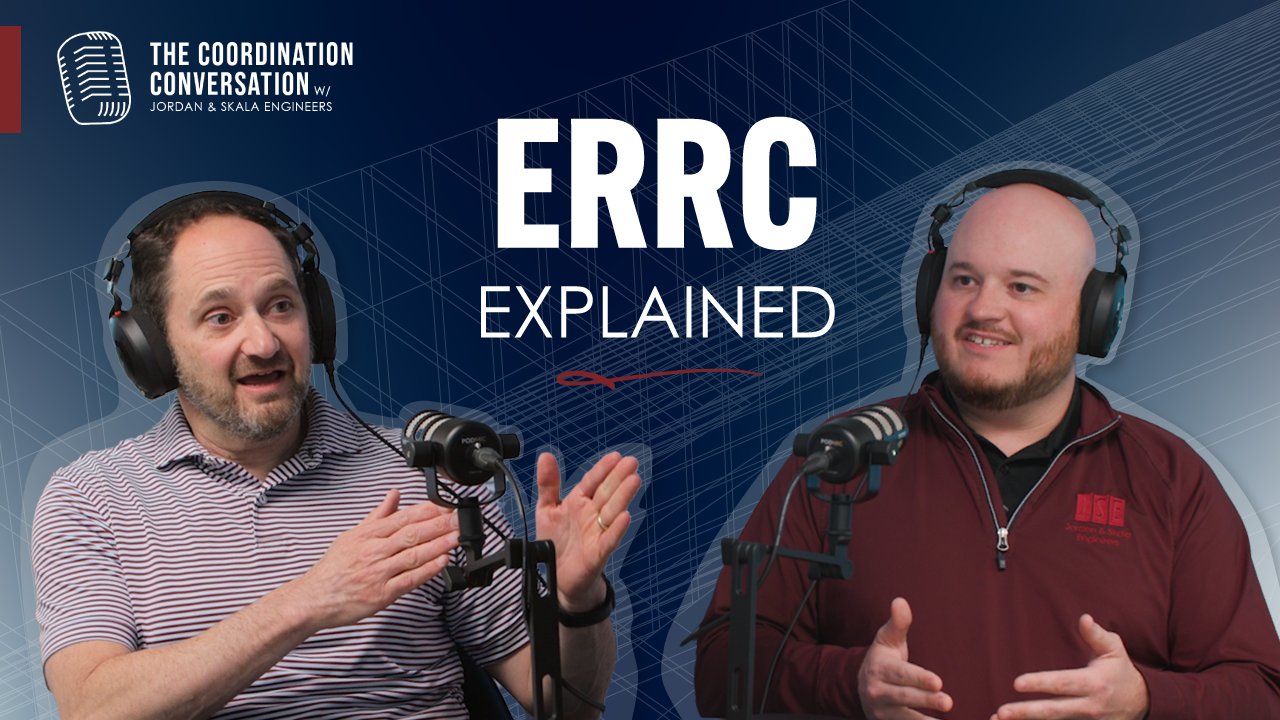
In this episode, host Andy Smith sits down with Brian Taylor, Director of Low Voltage at JSE, to unpack what ERRC actually is, why it exists, how codes have evolved, and what developers and design teams should be thinking about before they reach the certificate of occupancy.
Featured Topics from Our Latest Episode:
1. What Is ERRC and Why Does It Matter?
ERRC (also referred to as public safety DAS, two-way radio systems, or emergency radio enhancement systems) exists for one reason: to ensure first responders can communicate inside a building during an emergency.
As Brian explains, the modern push for ERRC traces directly back to the events of September 11, when communication failures inside high-rise buildings had tragic consequences. Since then, codes have evolved to ensure firefighters, police, and emergency personnel can communicate:
- Within the building
- Between floors
- And with command staff outside
Key Takeaways:
- ERRC is a life-safety system, not a convenience feature.
- It ensures reliable radio communication where building materials block signals.
- It protects both occupants and first responders during emergencies.
2. ERRC vs. DAS vs. “Whatever My City Calls It”
One of the biggest challenges with ERRC? The naming confusion.
While the International Fire Code refers to ERRC specifically, many owners and project teams use the umbrella term DAS (Distributed Antenna System), which can also mean cellular DAS (a non-required, luxury system).
Key Takeaways:
- ERRC ≠ cellular DAS
- Cellular DAS is optional; ERRC may be required
- Terminology varies by jurisdiction, code cycle, and AHJ interpretation
Understanding the distinction early can prevent costly misunderstandings later in design and construction.
3. Is ERRC Required in Every Building?
This is one of the most common misconceptions.
The code does not say “every building must install ERRC.” Instead, it requires:
- Minimum signal strength throughout 95% of the building
- Higher coverage requirements in critical areas like stairwells
If a building fails signal testing, ERRC becomes the solution.
Key Takeaways:
- Requirement is performance-based, not prescriptive
- Dense materials (steel, concrete, parking structures) often trigger ERRC
- Urban and high-rise projects are more likely to need systems
- Enforcement varies widely by state and city
4. How Codes Intersect: IFC, NFPA 72, and NFPA 1221/1225
ERRC design doesn’t live in a single code book.
- IFC defines when coverage is required
- NFPA 72 addresses system signaling and integration
- NFPA 1221 / 1225 address survivability, backbone protection, and system robustness
Over time, these codes have become more aligned but navigating them still requires experience.
Key Takeaways:
- Codes don’t conflict, but they do overlap
- Survivability requirements have evolved (and become more practical)
- Fully sprinklered buildings now have more flexibility than in the past
5. Backbone Survivability: Where Design, Cost, and Coordination Collide
One of the most misunderstood (and expensive) aspects of ERRC is backbone survivability, how long system cabling must survive during a fire.
As Brian explains, early coordination is everything.
Key Takeaways:
- Survivability can often be achieved through rated shafts or rooms
- Specialty fire-rated cabling is expensive and typically a last resort
- Late decisions = ceiling demolition, retrofits, and major cost impacts
- Early planning gives owners options
6. Three Levels of ERRC Design Services (And Why Option B Wins)
JSE approaches ERRC with flexibility, offering three levels of service depending on project risk, size, and certainty:
- Advisory / Code Confirmation
- Infrastructure Planning (most common)
- Full ERRC System Design
Key Takeaways:
- Infrastructure planning protects owners from future risk
- It allows projects to move forward without over-committing capital
- Retrofits are dramatically more expensive than planning ahead
What This Means for Developers, Architects, and Engineers
ERRC is no longer an edge-case requirement; it’s a project-defining life-safety consideration that can impact:
- Permitting timelines
- Construction costs
- Certificate of occupancy
- Long-term building compliance
At Jordan & Skala Engineers, our integrated MEP, Sustainability, and Low Voltage teams help clients navigate ERRC early so there are no surprises late.
Watch the full episode: ERRC Explained: Codes, Coverage, and Coordination
Meet Our Speakers

Andrew Smith
President

Brian Taylor
Principal/Director of Low Voltage
Leave a Reply
Want to join the discussion?Feel free to contribute!