
Microbiological Growth Mitigation in High-Humidity Climate Zones

A White Paper by Jordan & Skala Engineers, Inc.
Executive Summary
Projects located in high-humidity climate zones face an elevated risk of indoor moisture accumulation and subsequent microbiological growth development. These risks are amplified by the increasing use of smaller dwelling units, reduced HVAC loads, and locally controlled or natural ventilation strategies. This white paper outlines the primary conditions that contribute to microbiological growth risk, evaluates the performance limitations of traditional residential HVAC systems, and presents Jordan & Skala Engineers’ (JSE) recommended design strategies to improve indoor humidity control and reduce long-term liability.
Design Conditions That Increase Microbiological Growth Risk
There is a significant risk of microbiological growth in conditioned buildings when one or more of the following conditions exist:
- Climate Zones: The project is located in Climate Zone 1A, 2A, or 3A.
- Ventilation Strategy: The project includes locally controlled outside air fans or relies on natural ventilation in lieu of dedicated outside air systems.
- Dwelling Unit HVAC equipment: The project includes small-area, single-zone dwelling units that require HVAC capacities well below those available in traditional residential split-system heat pumps.
- Exhaust Wall Caps: Perimeter exhaust termination caps do not have updraft protection.
Issues in High-Humidity Climate Zones
Climate Zones
Climate Zones 1A, 2A, and 3A are historically at higher risk for indoor humidity and moisture-related issues (Figure-1). Most humidity-related concerns encountered by JSE occur within these zones. Project teams should reference the applicable climate zone map to confirm whether a project site falls within a high-humidity classification.
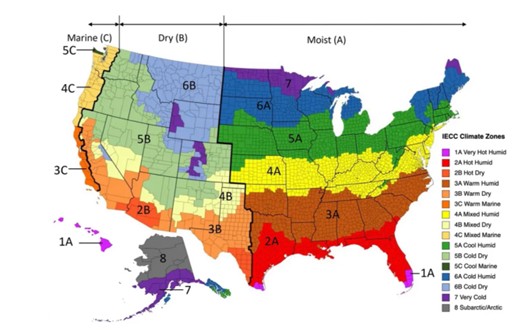
Figure-1
Ventilation strategy
Role of Dedicated Outdoor Air Systems (DOAS)
A Dedicated Outdoor Air System (DOAS) is the most effective and reliable method for preventing microbiological growth and managing indoor humidity in projects located in Climate Zones 1A, 2A, and 3A. When properly designed and commissioned, a DOAS actively conditions, pressurizes, and dehumidifies outdoor air before it is introduced into the occupied space, ensuring a consistently dry building environment.
DOAS units may be used in wood-frame construction, provided the total system capacity does not exceed 6,000 CFM.
Limitations of Locally Controlled Ventilation
When a DOAS is not approved because of project economics or an owner’s preference, locally controlled outside air fans within dwelling units may be used to satisfy the minimum continuous outdoor air requirements of the Authority Having Jurisdiction (AHJ). However, these systems inherently carry an elevated risk of microbiological growth, regardless of the HVAC system selected.
If outside air fans are not properly configured or correctly sequenced with the HVAC system, the likelihood of moisture accumulation and microbiological growth increases significantly. Even naturally ventilated dwelling units pose a humidity risk due to continuous or intermittent exhaust operation, which can draw humid outdoor air into the conditioned space.
Dwelling Unit HVAC Equipment
Limitations of Traditional Residential HVAC Systems
Traditional residential-grade split-system heat pumps start at a 1½-ton capacity. Modern residential projects, however, increasingly feature:
- Smaller square footage dwelling units
- Improved building envelopes and glazing
- High-efficiency lighting and appliances
These factors significantly reduce the calculated HVAC load, often well below the minimum capacity of traditional equipment.
Impact of Oversized HVAC Equipment
When HVAC equipment is oversized relative to the actual load, the system satisfies the space temperature too quickly. This results in short cycling, where the compressor frequently turns on and off rather than running for extended periods.
During summer operation, extended compressor run times are critical for effective moisture removal. While winter conditions naturally reduce indoor relative humidity and spring/fall provide limited dehumidification benefit, summer dehumidification through the HVAC system is the primary and most reliable method for controlling indoor moisture and preventing microbiological growth.
Jordan and Skala Engineers Recommended Solutions
Factory-Packaged Outside Air Ventilation Systems
JSE strongly recommends that outside air ventilation fans, controls, and dampers be provided as a factory-packaged system. Although field-installed, component-based systems can lower upfront costs and conserve space, they have traditionally presented considerable liability risks with regards to microbiological growth.
In multiple instances, improper control setup or value engineering of critical components by installing contractors has resulted in independent humidity issues within the conditioned space, separate from HVAC system performance.
A factory-packaged, plug-and-play system minimizes these risks by ensuring proper integration, sequencing, and performance.
Recommended Model
- Manufacturer: Broan (figure-2)
- Model: FIN-180-HW (Hard Wired)
- Airflow: 130 CFM (preferred), 180 CFM
- Control: Percentage-based continuous ventilation
- Estimated Premium: Approximately 20% above individual field-installed components
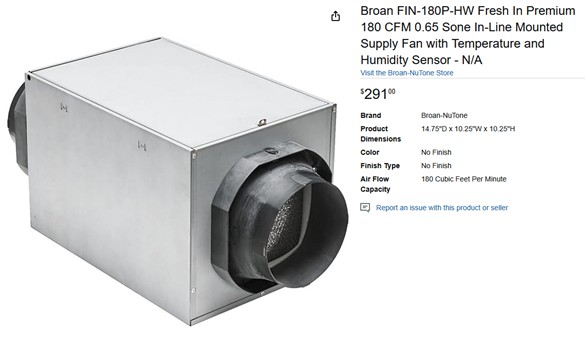
Figure-2
Install Split System Heat Pumps with Inverter-Driven Compressor Technology
Inverter-driven compressors offer a solution to the dehumidification limitations of traditional constant-speed systems. When the HVAC load is low, an inverter modulates compressor speed rather than cycling on and off. This allows the system to:
- Maintain the desired space temperature more consistently
- Operate for longer continuous periods
- Remove greater amounts of moisture as air passes over the evaporator coil
Field Performance Example
Daikin conducted a comparative field test in Atlanta using two 1½-ton Goodman split-system heat pumps serving identical conditioned spaces:
- Traditional constant-speed compressor system: Removed approximately 1 gallon of water per hour during peak summer conditions.
- Inverter-driven compressor system: Removed approximately 8 gallons of water per hour during the same conditions.
This test demonstrates that inverter technology delivers significantly improved humidity control and overall performance in high-humidity environments.
Manufacturer Availability and Cost Considerations
Both Goodman and Carrier now offer 1½-ton inverter-rated compressors in their residential split-system heat pump product lines. The installed cost is generally comparable to traditional residential-grade systems, as inverter-rated equipment often eliminates the need for supplemental electric heat.
At lower operating speeds, the heat of compression generated by inverter compressors provides additional heating capacity, particularly beneficial in Climate Zones 1A, 2A, and 3A.
While inverter technology provides value across all residential applications, it is especially advantageous when installed equipment capacity exceeds the calculated HVAC load.
Recommended Inverter Heat Pump Models
- Manufacturer: Goodman
- Heat Pump Model: GZV6VSA
- Fan Coil Unit (FCU) Model: AWE*
- Capacity Range: 13,000–17,000 BTUH
- Lineset Limits:
- 90 ft vertical (condenser above or below FCU)
- 125 ft equivalent length
- Manufacturer: Carrier
- Heat Pump Model: 37MUHA
- Fan Coil Unit (FCU) Model: FMA5*
- Capacity Range: 5,350–18,000 BTUH
- Lineset Limits:
- 65 ft vertical (condenser above or below FCU)
- 98 ft equivalent length
This equipment is primarily specified for buildings five stories or fewer. For six- and seven-story buildings, suitcase condensers should be located on balconies or at grade for the concrete levels.
Exhaust Wall Caps with Updraft Protection
In Climate Zones 1A, 2A, and 3A, all bathroom, dryer, range hood, and kitchen exhaust wall caps must include:
- Updraft protection
- Spring-loaded flapper dampers
Wind and general infiltration can force humid outdoor air back into exhaust ducts, leading to internal moisture accumulation. This condition is commonly observed by residents as condensate forming around the dryer drum.
Prohibited Components
- Wall caps with flush mounted flapper damper and no rain cap.
- Standard builder-grade or plastic wall caps are not acceptable in high-humidity climates.
Recommended Wall Cap
- Manufacturer: Imperial (Figure-3)
- Model: R2 Premium Wall Exhaust/Intake
- Neck Sizes: 3″, 4″, 5″, 6″, and 8″
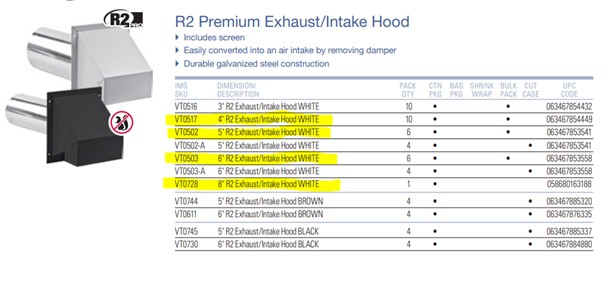
Figure-3
Conclusion and Standard of Care
Humidity control in Climate Zones 1A, 2A, and 3A has become a critical concern across JSE projects. Effective microbiological growth mitigation requires increased attention, interdisciplinary collaboration, and thoughtful evaluation of dwelling unit HVAC systems and ventilation strategies.
This white paper is provided as a standard of care for JSE projects and to highlight the inherent risks associated with design or construction shortcuts in high-humidity environments. Adherence to the recommendations outlined herein will significantly reduce the potential for moisture-related failures, microbiologic growth, and long-term liability.
Leave a Reply
Want to join the discussion?Feel free to contribute!